


|
|
|
|
 |
 |
   |
interview Aboard
the Pakistani rollercoaster Zia Mohyeddin column
"It's a fallacious notion that Pakistan will cease to exist" Nicholas Schmidle talks about his book To Live or To Perish Forever, learning Urdu and his time spent in Pakistan
By Huma Imtiaz Many a foreign journalist has crossed through Pakistan,
and written numerous stories, but few have had the impact that Nicholas
Schmidle had on the country, and even more so, the country's intelligence
apparatus. Reporting for various publications, Schmidle broke stories about
the next generation of Taliban, and wrote frequently about the ethnic,
religious and sectarian parties in Pakistan, along with the colourful
political characters in the corridors of power. These stories, as they often
do, not only created a sensation within Pakistan and abroad, but also caught
the eye of the secret agencies that govern Pakistan behind the scenes. So it
was no surprise when Schmidle was deported in 2007 and then forced to leave
soon after his return in 2008, after being allegedly trailed and harassed by
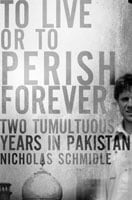
personnel of the intelligence agencies. Following his departure, Schmidle put his wealth of articles and information to good use: by compiling the best of his work in an explosive new book To Live or To Perish Forever: Two Tumultuous Years in Pakistan -- that is informative, poignant, ironic and terrifying, and an eye-opener, even for those living in Pakistan. However, he says, despite having wanted to write a book as a child, he had no book contract or agent when he came to Pakistan. "I didn't set out with the intention of writing a book. But I was in the country at a very unique and historical time and by the end of my time I knew I was going to write a book." Since Schmidle spent nearly two years in the country, and was writing constantly, one wonders how the process of deciding what made it to the book and what got axed was like. "I did revisit my articles and photographs, because I was writing constantly throughout my time in Pakistan for various publications. To Live or To Perish Forever proceeds chronologically as well. So when I was writing the book, I looked at pictures I'd taken and the journals I'd kept. There was a lot of stuff that was left out. There were personal stories of me and my wife Rikki going to the Shandur Polo Festival in 2006, etc, but it didn't weave itself into the book, and there were a lot of stories that I would've liked to have in there. This isn't supposed to be a comprehensive historical analysis of Pakistan. It is Pakistan through my eyes and, some of the stories I shared in the book were the most significant for me." Schmidle worked out of his home-office in Washington D.C writing the book. "I was able to spread out pictures and maps and notes at the home office. But when I was reporting, I often wrote on buses and trains and planes after returning back from a story outside of Islamabad. It's amazing how clear you can think when you're forced to turn off your cell phone or blackberry." Schmidle recalls his time spent in the country with his wife Rikki with fondness. "My wife and I had gotten past the point where we felt like visitors. Pakistan was home. So in that sense, there were good days and bad days like you'd expect everyone else has. But I got a rush from travelling around the country. Going to Shandur was an incredible experience for example. But really, it was the everyday experiences, seeing how Pakistanis could open up to two blond Americans, which was the most memorable part of being in Pakistan." The transition, in terms of language, was not hard for Schmidle. Having spent a summer in Tehran learning Persian, he was familiar with the alphabet and some of the basic words. With him and his wife taking tuitions for Urdu, mastering the language became an easier process. In the book, Schmidle mentions his time spent with the late Abdul Rasheed Ghazi from the Lal Masjid, with colourful anecdotes and mentions Ghazi helping Schmidle out with contacts with various religious/jihadi groups. In retrospect, Schmidle feels that Abdul Rasheed Ghazi became a victim of his own personality cult. "The Jaish-e-Mohammad members increasingly became his security guards throughout 2007, and they weren't about to let him back down in July 2007. Ghazi's charisma and leadership had brought them all to the brink. They were ready to go all the way. And while Ghazi was apparently negotiating for safe passage, they knew they would never get the same, and so we witnessed the final standoff at Lal Masjid." According to Schmidle, the appearance of former khatib of the Lal Masjid, Abdul Aziz, on state television after his arrest was a huge public relations blunder by Musharraf. "I feel the Pakistani intelligence apparatus still thinks that they can reign in and control these people, but it's not like that anymore." Yet being a foreigner in the country, and a journalist to boot, it is hard to get Pakistanis and Pakistani militants even more so, to open up. Did Schmidle feel that people like Abdul Rasheed Ghazi and others like him were holding out on information when he went to interview them? "It would be naïve to think that they didn't, but I was there for a long time and I knew enough, so I could always call them out on it. At the same time, I knew that Abdul Rasheed Ghazi too had very close ties with the Sipah Sahaba Pakistan, but he knew SSP didn't sell well with the American audience, and he never once mentioned it." Schmidle writes about the Binori Town seminary in Karachi, the rise of Maulana Fazlullah in Swat and the extremist sectarian parties of the country amongst others, which have played an important role in shaping the last two decades of Pakistan's history. Considering each party and group has a different agenda, which organisation poses the biggest danger to Pakistan at the moment? "Baitullah Mehsud's organisation poses the greatest threat in terms of capacity. Plus, they seem to represent and contain all the elements of the jihadist landscape: former Lal Masjid militants, Kashmiri militants, sectarian ones, etc. But as we saw in Gojra recently, the ideology of sectarian parties in Pakistan has had the most destructive effects on society. The sectarian ideology of Sipah-Sahaba or Lashkar-e-Jhangvi is just not something that I can comprehend." A blog written by Pakistanis, Five Rupees, described Schmidle as an anthropologist masquerading as a journalist. Schmidle says it's a very kind description by them. "If every story I do for the rest of my life has experts describing it as done by an anthropologist masquerading as a journalist that would be a great compliment." The book ends on a bitter note, Schmidle is forced to leave after hours of playing cloak and dagger with members of the intelligence agencies allegedly following him, preceded by false reports of him being kidnapped circulating in the media. Schmidle says his experience in Pakistan still feels unfinished and would like to come back to the country, but the final 24 hours he spent in Pakistan in August 2009 were incredibly unnerving, more so than the time he spent in Swat and Bannu. So will Pakistan live or perish forever? "I think Pakistan is more viable than most Americans like to think. Unfortunately, I think the state has failed in many cases to "sell" the idea of federation to people in, say, Balochistan or parts of NWFP or Sindh. It's a fallacious notion that Pakistan will cease to exist; the Pakistani people's resilience is greatly underestimated." Huma Imtiaz works as a correspondent for Geo News and can be reached at huma.imtiaz@gmail.com
Aboard the Pakistani rollercoaster To Live or To Perish Forever serves a fresh take on Pakistan To Live or To Perish Forever: Two Tumultuous Years in Pakistan By Nicholas Schmidle Publisher: Henry Holt and Co. Pages: 272 Price: Rs695 "The cops came for me on a cold, rainy night." The opening line of Nicholas Schmidle's To Live or To Perish Forever: Two Tumultuous Years in Pakistan does make one wonder if this is an adventure or suspense novel instead of a highly awaited narrative on Pakistan. But Schmidle's novel is no less fast-paced, there's violence, gore, deception and a good old-fashioned cloak and dagger escape. And if the book's a thriller, Schmidle has cast himself as the hero. Crossing through Pakistan and facing tear gas, the Taliban and witnessing clashes between ethnic parties, Schmidle braves it all -- only to be served once with deportation papers, and in the second instance, forced to catch a flight out of Pakistan. Schmidle's Pakistan, culled from impressions, interviews and travels during his two year stay in the country while working as a journalist, is full of intrigue, irony and drama. The book starts with Schmidle being served with deportation papers, and leads into an anecdote about how he gets out of the situation: via a contact calling in a favour, Pakistani-style. Reflecting Schmidle's experiences in Pakistan throughout his two years, the book is written in an engaging style, reminiscent of travelogues. The book chronicles Schmidle's years in Pakistan covering what has been an incredibly turbulent time for Pakistan. Schmidle touches upon his time spent covering the Lal Masjid operation and his experiences with Abdul Rasheed Ghazi, the bloodshed in Karachi on May 12, 2007, the Pakistani Taliban in Swat and the Frontier. Schmidle's account of his meetings with Abdul Rasheed Ghazi provides a valuable insight into the man who transitioned from helping Schmidle with contacts for interviews and yet brought fear and terror into the capital of the country. The book succeeds in touching upon, albeit briefly, the various problems that Pakistan has been facing over the last many years. Sectarian violence and the ideology fuelling it, ethnic violence in Karachi and interviews with MQM leader Farooq Sattar, and the separatist movement in Balochistan, all serve to highlight the fractures in the Land of the Pure. Schmidle's travels as a young foreign journalist make for an interesting read. Peppered with hilarious anecdotes, Schmidle sets off to Gwadar to meet the disillusioned Makrani fishermen and tries to find out the reality behind the notion spouted by the Pakistani government that Gwadar will be the next Dubai. In another chapter, he recounts being shown al Qaeda leader Ayman-al-Zawahiri's belongings, left behind after Zawahiri's visit to the Swat Valley. Schmidle successfully brings to life the colourful characters he encounters, whether it's the MQM leader Farooq Sattar, or the Jamaat-e-Ulema Islami head Maulana Fazlur Rehman; each story has vivid descriptions of the surrounding and the personalities, with their quotes adding to the enigmatic air that surrounds them. His bravery is evident too, Schmidle encounters surly and suspicious Army officials at the Gwadar airport, meets Maulana Fazlullah and witnesses a public lashing held by the Taliban in the Swat Valley. The book ends on a rather bitter note, Schmidle is forced to leave the country soon after returning in 2008, and his trip to the shrine of the Sufi saint Lal Shahbaz Qalandar is cut short as he catches a flight to Pakistan, fearing a threat that he may be picked up by the authorities. The book's title (also the same as a Rehmat Ali essay from 1933) and his quest to understand whether Pakistan would indeed, live or perish, and the factors behind it make for an engaging and eye-opening read, and remind one of the numerous problems, its history and significance, that this country faces, which are a dire threat to Pakistan's existence. However, To Live or To Perish Forever's short essays on problems facing Pakistan do not make for an in-depth assessment; rather it is a cursory look, but then the author only lived in the country for a mere two years. To Live or To Perish Forever serves as a reminder of what Pakistan went through till 2008, with immense political upheaval and insurgencies everywhere one looked. What really sets the book apart though is its refreshing take on Pakistan, and the Pakistani people. Despite the odd cliché thrown in here and there, Schmidle's depiction of Pakistan hits the nail squarely on its head -- chockfull of the dramas and deception that make up part of this country's social and political fabric. -- Huma Imtiaz
Loser achieves greatness Until this year, the longest tennis match that I had ever watched was a quarterfinal duel between Pancho Gonzales and Charlie Pasarell at Wimbledon. This was in the early sixties. In those days there was no such thing as a tie-break. A set did not end until one player had won two consecutive games after 6-all. The match went on until it was too dark to continue. Gonzales was an experienced, wily player who mixed his game with a lot of lobs and drop shots; Pasarell was a rookie who showed a tremendous amount of tenacity to keep pace with his opponent. He was 22 or 23; Gonzales was in his late thirties, perhaps even older. It was a wonderful exhibition of artistry and power play. Gonzales won the match the following day, but I wasn't there to watch it. This year's men's final at Wimbledon was gigantomachy. (I have been meaning to use this word but the occasion never arose). It was an unusually warm afternoon in London. I sat glued to my television set for four and a half hours. Would the match go no until nightfall? Now that they have a new roof over the centre court, with in-built lights, would they go on playing until midnight? I don't know about the players, but I was shattered. Roger Federer, was playing against Andy Roddick for the third or fourth time in a final of a Grand Slam championship. Federer had beaten Roddick on each occasion and everybody believed that Roddick had no chance against the world champion. He had been written off even before the match began, but Roddick matched Federer shot for shot for hours. The match became an epic final. Roddick had his chances. He won the first set almost comfortably 7-5, and he was leading 6-2 in the second set tie-break. He had four break points for a 2-0 lead that even Federer might not have overcome. But it was at this point that he lost his composure. The man, who had won 21 out of his last 23 tie-break sets, hit two wide volleys. This was the moment when the word "choked" began to be whispered. He was Misbah-ul-Haq needing three runs in four balls to win the match and the championship. He was like the golfer (I cannot recall his name) who missed a tiddly putt to lose the US. Open. But Roddick was no choker. He regrouped and held on until just succumbing in a tie-break in the third set. Federer now had a 2-1 lead in the match and all his fans -- the overwhelming majority of the spectators were Federer fans -- sat back, relaxed, comfortable in the knowledge that he would win three sets to one. Roddick did not give in. He won the fourth set 6-3, setting the scene for the final set showdown. As all tennis players know there is no tie-break in the fifth and final set. The final set was not so much a tennis match; it was more a bare-knuckle boxing fight that went on indefinitely. Finally, Roddick's legs began to buckle and his mind to wander. Federer moved in for the kill, wining the 5th set 16-14, by far the longest set in any final. Until that point he had not been able to break Roddick's serve throughout the match. An amazing revelation of this final was the change in Roddick's overall game. We had seen signs of it in his semi-final match again Andy Murray (Britain's last hope). The ball-thumper seemed to have acquired other virtues. His game was full of guile. It was, neater, sharper, crisper, more refined. The credit for this is given to his new coach who has been able to instil a gentler quality in Roddick's tennis. Alas! He still could not discover how to get Federer to lose his cool. It was a gladiatorial contest, conditioned entirely by the serves. Roddick's fierce serve is his strongest weapon. Amazingly enough, in this year's final, Federer out-aced his opponent. There was only one game in which he went behind 15-30, but he responded with three scorching aces. Roddick had the disadvantage of serving second in the final set which meant that if he fell behind, the match could be over in a flash. But time after time he held his own, not by fluke, or Federer's waywardness, but firmly, resolutely. He did not capitulate until the score stood at 14-14. And so, one incredible stroke was matched by another. The games-all score went on and on and it became apparent that the spectators would crack before the gladiators. It wasn't the first time that we learned that Roger Federer, the superb athlete, is a strokemaker of incredible inventiveness. This year he won his sixth Wimbledon title and a record 15th grand slam. Federer won the match but Roddick, though devastated, somehow managed to summon the ability to make a concession speech of almost heartbreaking grace. I do not remember when I have seen an American loser displaying such sporting quality at Wimbledon. Federer may have broken all records but Roddick achieved a kind of greatness too. You must have gathered by now that I am rather fond of tennis. My own tennis was ordinary; my world ranking (when I played regularly) would probably have been 11543 or worse, but like all tennis fans I keep abreast of all the grand slam events, Wimbledon, in particular. Lately, however I have gone off Wimbledon, not just because I cannot afford the soaring ticket price (some people paid £ 8000 for a ticket to watch the men's final this year) but because Wimbledon has now turned into a richly varnished, corporate circus in which female players grunt and holler like they were in the last stages of giving birth, and where strawberries and cream now cost more than the price of a jewel. Sour grapes, you might say, but the fact is that men's singles matches -- until the quarter final stage -- over the last few years, have been tedious contests. The players appear to be automatons who plod through every game as if each set were torture. The glorious game of tennis used to be played intensely, but the players exuded a joy which was transmitted to the spectators. True, the Nastases and the McEnroes threw their tantrums evoking an "Oh I say" murmur from the public-school educated spectators, but their love for the game permeated those who watched them. Alas that is not the scene today. |