



|
|
|
|
 |
 |
   |
issue city
calling The way we
were karachicharacter
issue Time to pay heed to nature's loud wake up call Global warming and environment issues are not too high on Karachi's priority list. Increasing sea levels and shortsighted planning by authorities are adding to a creeping environmental emergency. It is definitely time for an attitude change By Shahid Husain With population the size of Islamabad adding to
Karachi's 15 million population every year as a result of internal
migration, the mega city is bursting at its seams. Broken roads, scarcity of
water, frequent power breakdowns and load-shedding, menacing traffic flows,
dearth of schools and hospitals, malignant "The highest high tide of south of Karachi and Indus' deltaic region is very close to the astronomical high tide. Any increase in sea level as a result of climate change will inundate large areas of coastal locations," Dr. Shahid Amjad, Professor and Dean, Faculty of Marine Sciences, Lasbella University of Agriculture, Water and Marine Science tells Kolachi. Dr. Amjad is a former Director General of National Institute of Oceanography, Karachi and his views are highly respected. "The impact of global warming will occur on the fringes of ecosystem. Pakistan is on the fringe of tropical ecosystem. The prominent effect will occur on the coastal ecosystem. In particular, it will impact the mean sea level. The pronounced impact will be on the rise in sea level that will be more towards the landward boundaries. We will see greater erosion of the coastal agricultural land. The movement of seawater in land to the river will cause rise in soil salinity. "The other impact will be on vegetation and plants
etc. We will witness increased plants and vegetation Over a time period of 150 years Karachi has been transformed from a sleepy fishing village to a megalopolis, essentially because of massive migration from India after Pakistan achieved independence in August 1947, followed by rapid industrialization that brought people in its fold from every nook and corner of the country that were in search of a livelihood. In the aftermath of the Afghan War millions of uprooted refugees from that war-torn country also made the city their home. Then there is a significant population of Bengalis, Iranians, Arabs, Burmese and even Sri Lankans who have found refuge in Pakistan's largest urban centre. "With approximately 15 million residents, the
metropolis is one of the largest cities in the world and continues to grow
rapidly. According to estimates, the population will double by 2025 if this
trend is "Only the city district of Karachi has a road network, which encompasses about 5,000 kilometers. Approximately 1.5 million automobile drivers are officially registered. The traffic density increases by ten percent annually," the report adds. While the chimneys of industrial units spew smoke unabashedly, contributing their due share to the hole in ozone layer and carbon monoxide emanating from buses, automobiles and rickshaws have made the lives of city inhabitants miserable, making them prone to a host of diseases, cutting of mangroves is making Karachi vulnerable to tsunamis. On the top of that global warming, it is being speculated, is a real threat. "The west and east coasts of Karachi are already low-lying and the slightest sea level rise will very adversely impact the local population of these areas," says Tahir Qureshi, Director, Coastal Ecosystem, the World Conservation Union-Pakistan (IUCN-P). "In 1991 IUCN-P in collaboration with the National Institute of Oceanography (NIO) conducted a study on sea level rise along the coast of Karachi. It was a six-month study and the results of the study were not significant except that it was estimated that 1.5mm is the sea level rise in this area," he adds. "For such a phenomenon a long-term study is required very urgently which should not only include the creek system but also the shallow waters in the open sea," he suggests. One-third of Karachi's population has no facility for
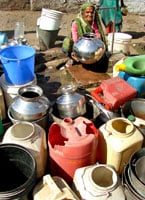
piped water and the city faces acute shortage of "Glaciers have been receding over the past four decades, as the world has gradually warmed up, but the process has now accelerated alarmingly. Average temperatures in Tibet have risen by 2 degrees Fahrenheit over the past 20 years, causing the glaciers to shrink by 7 per cent a year, which means that they will halve every 10 years," says The Independent newspaper citing scientists of the Chinese Academy of Sciences. "Perhaps worst of all, the melting threatens to disrupt water supplies over much of Asia. Many of the continent's greatest rivers-including the Yangtze, the Indus, the Ganges, the Brahmaputra, the Mekong and the Yellow River-rise on the plateau," it cautions. Since River Indus happens to be the main source of water supply to Karachi, Hub Dam not being reliable, reduction of water in the once mighty river as a result of global warming and construction of dams upstream will adversely affect the supplies to the city. Given the fact that the fertile Indus Delta has been transformed into a wasteland due to absence of freshwater downstream Kotri barrage, and building of large dams upstream, global warming would have disastrous effects on the supplies of freshwater to Karachi and other areas of Pakistan. The havoc caused by the myopic policies of successive governments in Pakistan can be gauged from the fact that diversion of water have resulted in massive sea intrusion upstream into the River Indus up to 57km that has impacted freshwater fishery and riverine agriculture, according to Qureshi. The authorities are ruthlessly cutting mangrove forests irrespective of the fact that precious species are natural barriers to tsunamis. The most recent example is the brutal chopping of mangrove trees over Bundal and Buddo islands near Karachi which are spread over 10,000 hectares. "The
total area of mangrove forests in Sindh's Indus Delta is about 250,000
hectares and that of Balochistan's Mekran coast is now estimated at only
7,500 hectares, i.e. 3% of the total mangrove forest coverage at the coastal
areas of Pakistan. In view of their relatively small coverage, the mangroves
in Balochistan could easily disappear if proper action is not taken, while
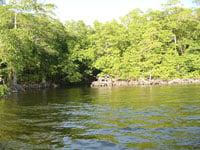
those of Sindh are under severe The report further says: "The mangroves in the Indus Delta are listed as the world's sixth largest contiguous mangrove area...Until recently, mangroves were considered as mosquito infected wastelands of no particular value. Today, conservation values of mangroves and the ecological services they provide have been well documented. Studies have shown that some 60-80% of the world's commercial fisheries catch are mangrove dependent species. The Indus Delta is considered as a coastal zone of very high economic and bio-ecological value. It is the main fish and shrimp nursery on which Pakistan's fishing industry depends. Hundreds of thousands of people are directly dependent on the mangrove ecosystem for their livelihood." Furthermore, mangroves deflect cyclones and tsunamis and help in containing soil erosion as has been proved during the recent tsunami that brought havoc in Indonesia and Sri Lanka. But instead of conserving them, the short-sighted planners in Pakistan are destroying them ruthlessly. In the Mai Kolachi area in Karachi as elsewhere in the country, mangroves are being cut to reclaim land, making the metropolis prone to cyclones and tsunamis irrespective of the fact that these precious species deflect cyclones. Mohammad Nauman, an associate professor at Karachi's prestigious NED University of Engineering and Technology says that cutting of mangroves has also resulted in increased siltation of Karachi Port to the extent that dredging cost will become unbearable in the near future. Global warming is also impacting the weather pattern in Karachi and other parts of Pakistan. "Extreme weather events in Pakistan as well as in other countries are on the rise. For example, last year we had freezing temperature in Sindh. Similarly, this year too, we had an extended cold wave affecting most parts of the country, including Karachi. During the last monsoon, Sindh witnessed urban flooding in Hyderabad and adjoining areas and about two years back Balochistan received 70 years record winter rainfall that caused extensive flooding. Many other such examples can be quoted to highlight that climate change due to global warming is already affecting our country as well," says Dr. Qamaruzzaman Chaudhry, director general, Meteorological Department of Pakistan. It's a creeping emergency and one need not say that every nation has to adopt drastic measures to deal with rise in sea level and other manifestations of global warming. In developing countries like Pakistan where environment has always been a low priority area an awareness campaign regarding global warming has become all the more necessary. "Many of the world's largest and richest cities are at sea level. Dozens of cities will suffer total or partial inundation if they do not raise defenses against the sea," writes Paul Brown, former environment correspondent in London of the prestigious Guardian newspaper in his recent book "Global Warming The Last Chance for Change." Will our planners also pay heed to the wake up call?
city
calling Karachi once had a vibrant literary circuit and enthusiastic readers. Kolachi reviews changing trends in Karachi's book culture By Bilal Tanweer Mohammed Tariq, librarian at Frere Hall Library reports
that the library, about ten years ago had over 3,000 subscribed members and
hundreds used to frequent the library every day. At present, the membership
has dwindled to dozens and hardly ten people visit the library in a day.
This, one might argue, is because of security procedures. But other
libraries in the city tell the same story. No new book acquisitions have
been made since past three to five years; allocated funds for book
acquisition and Number of libraries is just one indicator. There are others, for instance, the number of books published. "The print run of a book is usually between five hundred and a thousand, which also translates into higher price for the reader," says Hoori Noorani, owner of the publishing house Maktaba-e Daniyal. N. M. Rashed, one of Urdu's leading modern poets, has been out of print for the past one year. His poetry, considered to be in the same league as Faiz and Mira Ji, is not available. Yet another indicator is the number and quality of bookstores. In our neighbour countries one finds bookstores that climb four-stories, low-priced editions of almost all books, thriving publishing houses, et al. However, quality bookshops in Karachi are, by and large, extinct. Even the best of the lot, e.g. Liberty Books do not have any significant offerings on subjects like philosophy and history. Bookstores in Urdu Bazaar are polarized with literature in Urdu. This was not always the case, says, Hussain Shah, a Karachiite and a book lover, "There were so many more bookstores in Urdu Bazaar. You could find almost any book in English or Urdu there. I could tell you about so many book stores that are not there any more." According a survey conducted in 1967, there were 17 non-text book bookshops in Saddar in 1967; till 1995, 5 had survived. A superficial answer to the decline of public readership is the rise of mass-media, especially the internet. However, if this was true then it would be most true for the West - which, of course, is manifestly untrue. Book trade in the West flourishing like never before in human history. Europe, according to a figure, produces more than ten-thousand new novels every year. Besides, question of Internet replacing local literature is preposterous, for the latter is not available on the Internet, and whatever exists is negligible. Hoori Noorani believes that the problem is the lack of institutions and not with the reading public. "I do not think that people have grown averse to reading. It is just that access to books has been made difficult. Comparatively, books cost much higher in Pakistan than in other South Asian countries. Paper is expensive, and because books are printed in such low numbers, the cost per unit is also high." However, Dr. Asif Farrukhi, writer and the editor of the
Urdu journal 'Duniya Zaad', is not so optimistic. "Educational
institutions have to take a lot of blame for people's increasing
disinclination towards literature. The quality of education has rendered
people indifferent to reading, and at worst, fear reading; it has made them
'aliterate', which is worse than illiterate. Teachers are incompetent and do
not The deterioration of informal cultural institutions is yet another reason. Alongside lovers of literature, Karachi also had thriving tea-shops, old-bookstores, and other places where writers would meet to discuss literature. Dr. Farrukhi laments, "When young people tell me that there are no places they can go to for cultural learning, it sends a chill down my spine. This city had one of the most enthusiastic reading public. We had mentors, people who would guide us in matters pertaining to literature, train us in writing and reading, and would roam around the streets when they discovered a new or exciting book." There has also been an alarming trend towards right-wing
literature. Islamic bookstores have mushroomed all around the city,
especially in middle-income areas. Rahim Ali, owner of Islami Kutub Khaana
and One thing that everyone agrees upon is that the state needs to play an active role if a culture of learning has to be revived in Karachi. As a matter of policy, one does not have to look very far. If a good and efficient library-network could be built in the city and every public park is given a library, managed and maintained, it could have far-reaching effects on both the publishing industry and the reading public. Publishers will have regular clients, readers will have access to books and reading space (also non-existing in the city), and writers will have a place to interact with their readers. Such an infrastructure is the most basic investment that the present government can make in enlightening this moderately literate nation.
The
way we were By Kaleem Omar There were no high-rises in Karachi in the days of the British Raj. Except for some structures in Kharadar and Mithadar, very few buildings were more than two storeys high. The first high-rise apartment-building - Rimpa Plaza, on what was then Drigh Road (now Shahrah-e-Faisal) - wasn't constructed until the mid-1970s. We've more than made up for this late start since then. Thousands of high-rise buildings now dot Karachi's landscape like rank upon rank of monstrous carbuncles. For all its high-rises, however, Karachi still has some neighbourhoods that are the way they used to be fifty years ago. But even these neighbourhoods are under increasing threat from venal real-estate builders hell bent on tearing down graceful old structures and replacing them with high-rises - one more ghastly than the next. This assault on the city's heritage is proceeding at such an alarming rate that the Karachi of the old days may soon be a thing of the past. The departure of the British from this part of the world in 1947 was followed within a decade by the advent of several things in Britain itself. The list was a pretty mixed bag that included the good, the not so good and the downright bad. Among the bad were the emergence of racism and the rise of high-rise buildings, concrete monstrosities also known as tower blocks. Before 1952, the British were not unfamiliar with blacks or South Asians. There had, in fact, been a large contingent of black Americans among the GIs in wartime Britain and South Asian students were frequently seen in London. However, the increasing number of immigrants who arrived from the West Indies, with British passports and automatic rights to settle, suggested a new, more permanent situation. The West Indians came for jobs, some of which, such as work with London Transport, had been advertised in their homelands as a means of overcoming the labour shortage in postwar Britain. But finding a place to live proved more difficult for many of them: before long, house-owners with rooms to let were putting up notices saying "No Blacks". The West Indians - some of whom solved their accommodation problems by buying and renting out houses themselves - settled in London and also further afield, in Yorkshire and the West Midlands. By the mid-1950s, the Jews whose culture had enlivened the East End of London, had largely moved on and the West Indians began to replace them. The East End and other London suburbs, such as Cricklewood or Kilburn, took on a whole new atmosphere. The West Indians brought with them their lively, rhythmic music, their own choice of foods, their colourful style of dress and, in time, their extended families, who were forced to live in small houses and flats never designed to hold so many people. The housing shortage was one of the factors that prompted the construction of high-rise residential buildings in London. The first tower blocks were built in 1958, and they soon came to dot the skyline in districts like Pimlico, Earl's Court and chunks of North London. These concrete carbuncles threatened to ruin many wonderful old parts of London, and probably would have done so if it hadn't been for the emergence of a populist resistance movement in the mid-1960s, when people living in primarily residential areas began to form "street associations" to combat plans by rapacious real-estate developers to build more tower blocks. The street associations pushed through legislation that made planning permission hearings open to the public and made it mandatory for planning authorities to hear the points of view of the street associations before according approval to the construction of tower blocks in their neighbourhoods. The movement soon spread to other parts of Britain, slowing down the rush by developers to build more and more residential tower blocks. Despite this resistance, however, high-rise residential buildings continued to be built, contributing to the ghettoisation of London and other cities in Britain. These ghettoes, in turn, added to the fuelling of racial tensions. Although the West Indian newcomers arriving in Britain in the early 1950s had settled peacefully, racial tensions began to build up and in 1958, in Notting Hill, London, they erupted. On 9 September that year, a group of white youths taunted blacks living in a house in Notting Hill Gate. The blacks answered back with a hail of milk bottles and a homemade petrol bomb. The police arrived to find blacks and whites embroiled in violent fighting. Before order was restored, there were many serious injuries and 59 people were arrested and charged with using offensive weapons. It became clear before long that the resentment against blacks that had been at the root of the problem was widespread. By 1963, popular concern was such that the government had to take action. New rules imposing work permits on immigrants came into force at midnight on 1 July, 1963. The new rules were strictly enforced: many Indians and Pakistanis without work permits were repatriated to their home countries. The government action of 1963 did little to solve the problem of rising racial tensions. Race hatred and the idea that Britain was going to be "swamped" by a rising tide of immigrants gained ground fast among Britons in the years that followed. On 6 May, 1968, at a time when 50,000 dependents of immigrants were being admitted to Britain each year, the right-wing Conservative MP Enoch Powell gave a speech in Birmingham in which he predicted "rivers of blood" as a result of this policy. His speech sparked off vigorous support from some 74% of Britons polled on the subject, and in a protest march from London dockers. The West Indians were deeply disturbed by the hatred rising against them. From their viewpoint, the country which had apparently welcomed them and allowed them to settle was becoming full of enemies. The first generation of West Indians in Britain were known for their politeness. But the younger ones, those who would have to make their way in an increasingly hostile atmosphere, began to feel they could not afford to behave so well and that fighting for the rights they had been promised was going to prove the only way to obtain those rights. When Uganda achieved independence in 1962 and Kenya in 1963, their minority Indian population received British passports in case, one day, they had to leave. Possibility became reality in Kenya in 1969 and in Uganda in 1972, when the governments of these countries decided to expel the Indians, whose forebears had come to Africa in British colonial times, many of them to work as labourers on Cecil Rhodes' "Cape Town-to-Cairo" railway project. Their descendants became traders. In Kenya, the Indians' trading licences were taken away, leaving them with no means of making a living. In Uganda, the Idi Amin military government accused them of sabotaging the economy. Some 10,000 Indians had already left Kenya in 1968 and in 1969 another 15,000 followed. In 1972, 50,000 Indians were expelled from Uganda and arrived in the UK, thanks to their British passports, with an automatic right to settle in Britain. Many Kenyan and Ugandan Asians had never seen India itself but nevertheless preserved their Indian culture and, once transplanted in Britain, they went on doing so. Like many previous immigrant groups, they lived largely within their own communities and followed their own customs, as did the Pakistani immigrants who had begun flocking to Britain in increasing numbers since the mid-1950s. Youngsters born in Britain to West Indian parents were also under racial pressure and they attracted a great deal of discrimination. Black dislike of the whites ran no less deep. Young blacks chafed at jobs denied them because of their skin colour. Blacks who committed crimes were often dealt with far more roughly by the police than whites in the same situation. All this planted a deep distrust of the police in young black minds and, in 1981, helped fuel a horrific series of violent and destructive riots in Toxteth, Liverpool and Brixton, London, where shops were looted, vandalised and set on fire. The racial harmony of the early 1950s was now only a distant memory.
karachicharacter By Nabeel Naqvi Muhammad Meraj a 22-year
old works as a salesman at a bakery in the Northern outskirts of Karachi.
Meraj, a soft-spoken person with a gentle personality, is more commonly
known as Majju. He passed his matriculation exams five years ago, but
because his father had retired in the meantime, Majju had to bid farewell to
his studies. He's a diehard cricket fan and is always interested in knowing
the latest score, he says he loves cricket and keeps himself updated about
the latest happenings in the world of cricket. Kolachi: Were you born here or have you migrated to the city of lights like millions of others? Majju: I was born in Karachi and have lived here all my life. My father worked in the Pakistan Telecommunications. I have two sisters and a 15-year-old brother. Kolachi: You said you have done your matriculation some 5-6 years ago. Why did you discontinue your studies? Majju: Well, I am the eldest and when my father retired I felt it was time for me to do something. So, I started working here, first I was one of the salesmen and now I am the head, because I have worked here longer than anybody else. Kolachi: How long have you been working here? Majju: For the past 6
years. My working hours start from four in the evening and continue to
midnight; Kolachi: How do you manage to attend family gatherings and functions? Majju: Well my employers allow me to take a day off when I need one - there is no such restriction. Kolachi: Do you regret quitting studies so early? Majju: Yes, I do sometimes, but the situation I was in back then required me to quit studies and look for a job; even though I had done my matriculation from the technical board with a B-grade. I had plans for studying at some latter stage in my life but that never happened. Kolachi: And about your friends at school, what did they end up doing? Majju: A couple of my friends passed Intermediate, and few even did their graduation and are now working in good firms. Most of them however, have started their own businesses and are doing pretty good. Kolachi: How much do you earn? Why didn't you try for a job that suited your technical education? Majju: My monthly salary is 3000 rupees and I am pretty satisfied working here. And as far as a job that suited my degree is concerned, such jobs require you to be a diploma holder. I don't have time to do a diploma because I have responsibilities of a family on my shoulders. I realize that I can get a better job now. As a matter of fact I have submitted applications at various places lets see what happens. Kolachi: Is what you earn enough to manage your expenses? Majju: Actually this is not the only thing I do; my father has a couple of small shops that we have rented out. In addition to this I run a side business of livestock. Mashallah it is working quite well. Kolachi: Tell us something about your family. Majju: One of my sisters is married, my brother studied till the seventh grade. But he wasn't interested in studies anymore - although we tried, even forcefully persuaded him to study but he was just not in favour of continuing. He now works at a mobile market, and is quite happy working there. I still want him to study more because I know its better for him but so far he is concentrating on his job. Kolachi: What do you have to say about employment chances here in Karachi? Majju: It is good, but then again I have seen many guys who are unemployed although they have acquired high education. Many then chose to go abroad in search of a better future. Kolachi: What are your plans for the future? Majju: As far as I don't find a better job I am happy working here. As a matter of fact for the past couple of years I have been trying to go abroad and for this purpose I have obtained a passport also. Kolachi: Yet another Pakistani going to Dubai, is it? Majju: No, not Dubai, I am trying for Malaysia! Kolachi: Why Malaysia? Do you have relatives there? Majju: One of my relatives is working there in a utility store and he offered me a job there. Inshallah as soon as our situation becomes favorable I'll leave for Malaysia. Kolachi: What are your other interests? Majju: I love cricket! I used to play cricket with my friends before I started working here. Besides cricket I love pigeons too, it's in my blood. Kolachi: As a native Karachiite how do you like this city and its people? Majju: Karachi is a great city. You'll find all sorts of people here, there are good people and then there are the 'not so good' people. Bhookon ki maa hai Karachi and is of course the largest city in Pakistan, there is no other city like Karachi! Kolachi: When are you getting married? Majju: (Smiles) Well, I have not yet given that a thought; you see I am not even engaged yet. So, as long as I don't find myself a decent job I don't think it will be wise for me to consider marriage. But, I have faith in Allah and I am quite hopeful about my future. Managing a whole family at a tender age of 22, Meraj only thinks about bettering the lives of his parents and siblings. He fulfills what is expected off him and does it well. Majju is doing his best to not only meet his family's expectations but to surpass them one day. Resilient and exuding positivity all the way such is Karachi's character. |
|
 aggression, rising tide of
violence and drugs and arms culture have taken the financial hub of Pakistan
by a storm. But more importantly, the city is also prone to natural
calamities due to global warming.
aggression, rising tide of
violence and drugs and arms culture have taken the financial hub of Pakistan
by a storm. But more importantly, the city is also prone to natural
calamities due to global warming.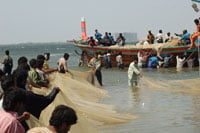 due to increase in
atmospheric temperature. This, in turn, will deplete soil nutrition at a
greater pace, thereby rapidly making soil less fertile," he elaborates.
due to increase in
atmospheric temperature. This, in turn, will deplete soil nutrition at a
greater pace, thereby rapidly making soil less fertile," he elaborates.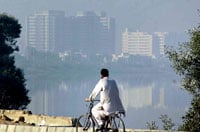 sustained," says a report by Siemens, a multinational company.
 water and given the fact
that Tibetan glaciers are melting fast as a result of global warming, one
can foresee water riots in not too distant a future.
water and given the fact
that Tibetan glaciers are melting fast as a result of global warming, one
can foresee water riots in not too distant a future.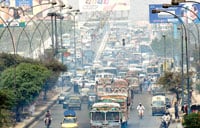 pressure," according to the Tropical
Rainforest Portfolio 1996-2001, a report compiled by the Directorate General
for International Cooperation (DGIS), Ministry of Foreign Affairs, The
Hague, The Netherlands, and the WWF-Zeist, The Netherlands.
pressure," according to the Tropical
Rainforest Portfolio 1996-2001, a report compiled by the Directorate General
for International Cooperation (DGIS), Ministry of Foreign Affairs, The
Hague, The Netherlands, and the WWF-Zeist, The Netherlands.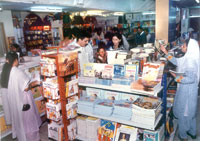 maintenance do not reach libraries; best public libraries do
not even have the most basic facilities like a photocopying machine. This is
reflective of present state of Karachi's culture of learning at large.
maintenance do not reach libraries; best public libraries do
not even have the most basic facilities like a photocopying machine. This is
reflective of present state of Karachi's culture of learning at large.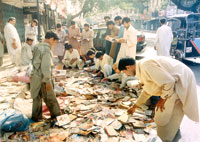 understand literature. And when such is the case, how does one expect
them to equip the young with the ability to appreciate the written
word?"
understand literature. And when such is the case, how does one expect
them to equip the young with the ability to appreciate the written
word?"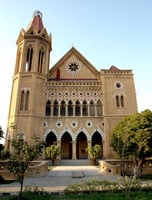 Casette Shop in F. B. Area said, "People are slowly coming back to
religion. Mashallah, there is a growing demand for religious books. We are
satisfied with our sales. But most of our customers are regular ones... Of
course, as Islam spreads, so will the readership of these books."
Casette Shop in F. B. Area said, "People are slowly coming back to
religion. Mashallah, there is a growing demand for religious books. We are
satisfied with our sales. But most of our customers are regular ones... Of
course, as Islam spreads, so will the readership of these books."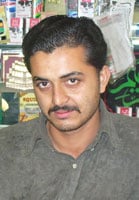 Kolachi got a chance to
interview him; Majju was really excited at being interviewed.
Kolachi got a chance to
interview him; Majju was really excited at being interviewed. there are no off days, and I have to come here 365 days a year. My
home is nearby so I get a half an hour dinner break. Before this I used to
work at a garments factory but had to quit due to some reasons.
there are no off days, and I have to come here 365 days a year. My
home is nearby so I get a half an hour dinner break. Before this I used to
work at a garments factory but had to quit due to some reasons.