|
|
| |
When art and technology collide
Special effects generated by computers have been embraced
by movie makers and viewers alike. They make for fantastic situations
that in turn add to the thrill of cinema. Here's to the power
of imagination and the technical know how that makes it all possible.
By Jazib Zahir
|
| |
| A
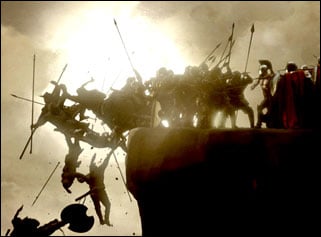
handful of Spartan soldiers close in on a sea of Persians. Slowly
and excruciatingly, the Persians are forced over the edge of the cliff
and hundreds plummet to their deaths. The scene jerks to a stop and
captures the instantaneous levitation prior to the free fall. A hazy
sun can be seen peeking through the cloud of dust kicked up by this
scuffle and the waters below thunder as they devour the falling bodies.
This is just one of many breathtaking visuals served up by the movie
300 which chronicles the epic battle of Thermopylae. |
 |
| |
Except
that outside of a computer screen, only half a dozen people were acting
out the scene. The elements of sunlight, dust and water were absent
and those deemed to plummet just dropped casually into the comfortable
foam below. Indeed, barring a few scenes requiring space to accommodate
galloping horses, 300 is largely a movie of select actors performing
before a vast blue screen which is later touched up by a dedicated
team of computer effects artists.
As you may expect from a movie with a number as its title, quantity
is the essence of the plot. It is the ability to represent thousands
of soldiers and showers of arrows with a few skillful keystrokes that
made this movie of epic proportions possible. It allowed the directors
to train a handful of actors on how to carry themselves in the battlefield
and their actions were easily replicated by computer to others. Scenes
involving ships being battered by storms and buildings being razed
to the ground were brought to life through the wonders of software.
While this work needs to be painstakingly precise to be realistic,
it still proves significantly more economical than attempting to harness
the elements of nature to generate these moments in the flesh. It
was this mechanism that enabled the production of a complex movie
within an acceptable time and budget.
The effects are not merely tools to fill in the vast spaces on the
screen; they are intricately tied into the pulse of the movie. They
slow down and speed up the action to simulate how the actors are visualizing
motion. They play with the weather and with background noises, allowing
the directors to sway our moods and emotions as we watch. |
| |
| Technical enhancements
have always had their place in Hollywood and have evolved with better
technology and higher expectations. There is even a special category
for Visual and Special Effects at the Oscars that aims to recognize
the film that has most effectively incorporated such capabilities
into its production. The first film to earn this distinction, The
Rains Came was honored in 1939 for its realistic depiction of storms
and flooding sequences through some camera techniques and creative
sound effects. Such an effort was very innovative for its times but
is a far cry from the dazzling effects seen today in films such as
the Star Wars and Matrix series. |
 |
| |
And
it's not just expansive battle sequences and graphic gore that benefit
from digital paintbrushes. The memorable scene from Forrest Gump involving
a ping pong ball ricocheting rapidly back and forth across the table
is a product of computer artistry too. While it is conceivable that
such a scene could be filmed without the need to resort to special
effects, having this option allows directors to capture the precise
action they want exactly when they require it.
Computer wizardry is not exclusive to the magic wand of Hollywood.
Indeed, a significant chunk of the crowd we eyeballed in Lagaan had
no existence outside of software specifically tailored for that purpose.
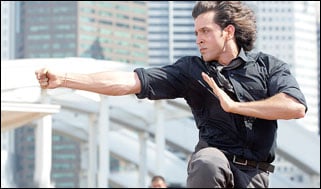
Bollywood is increasingly at home with special effects from the leaps
and bounds of superhero Krrish to peppering the screen with digital
snow in Black. Another commendable achievement of Bollywood is the
use of technology to breathe new life into classic films like Mughal-e-Azam
by re-creating them in today's hues and sharper imagery.
Closer to home, the Pakistani film industry is still in its infancy
as far as special effects are concerned. On record, the first movie
to employ any form of computer enhancement was Shani in 1989. Budget
limitations and technical inadequacies have conspired to ensure that
Pakistani films have not been able to move into a period of enlightenment
as far as graphics are concerned. Even Zibahkhana, which claims to
be our maiden attempt at a classic horror flick, relies heavily on
make-up and sound effects with seemingly little use of computer power
to lift the gore to a whole new plane.
Bollywood has embraced special effects because directors have shrewdly
identified this tool as a great leveler that allows them to compete
better with Hollywood's superior budgets. Indeed, India is such a
hub of technology with its legions of cheap but skilled labor that
the outsourcing boom is extending to the movie sector and the back
offices of Hollywood are shifting to Chennai and Hyderabad. While
Pakistan does not boast quite the same critical mass of technical
labour, it has been moderately successful in several outsourced industries
and there is no reason it cannot emulate India's success by investing
some resources in this area.
But amid the hoopla surrounding the digital wonders, we need to remember
that like sound and costumes, special effects are mere accessories
and the results hinge upon how well they are employed. Ang Lee drew
critical acclaim for his use of effects in Crouching Tiger Hidden
Dragon which released his characters from the strings of gravity.
But in The Incredible Hulk the effects often came across as comical
and the appearance of the protagonist did not mesh well with the backgrounds.
Ang Lee himself expressed dissatisfaction with the computer effects
in the movie suggesting that the technical component in contemporary
films may alienate some directors.
The movie industry has been built on innovation. From silent actions
to crisp dialogue and from black and white filming to a full palette
of colors, it is these very evolutions that have sustained the enterprise.
There are movies like Water World that have not garnered appreciation
despite their extreme emphasis on special effects. Others like Gladiator
have earned plaudits for their judicious use of such features.
Bollywood may be emphasizing the eye candy, but it also remains true
to its basic ingredients of poignant family relations, elaborate dance
sequences and chart-busting song numbers. Both the creators and the
critics seem to agree that a great movie is not just a product of
its visuals but an amalgamation of intangibles that speak to us well
after the lights are back on and we have departed from the cinema.
|
| |
|