|
|
| |
From
to Seoul to Lollywood
The Korean film industry faces stiff competition from global
cinema. But with a variety in subject and world class technology,
it is inspirational. Lollywood, take notice!
By Aijaz
Gul
|
| |
An
eight-day visit to Seoul to study various aspects of Korean films
would inevitably compel one to compare the Pakistani and Korean
film industries. Both nations face an immense amount of competition
from the highly developed film industries of India and USA. However,
a lesson lies in the difference in how the two nations have dealt
with their competition to harbour growth for their own industries.
|
| |
|
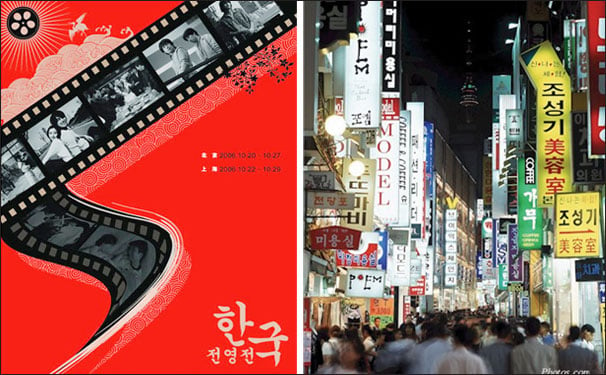
Slow,
steady growth: Focus on visuals, diverse stories and promotion of
talent-these factors have given Korean cinema a leg to stand on |
In Korea, the local film industry must compete with the entire world
but their biggest competition comes from Hollywood. This is because
the government has decided to reduce the minimum time requirement
(quota) of playing Korean films in all cinemas to a mere six weeks
in a year. This means that all cinemas in Korea can now play foreign
films for the rest of the 46 weeks in the year. While it may seem
like the government is not protecting the local industry, what the
government is actually doing is a positive step. Despite the fact
that in the last two years, the local big-budget films have not done
well at the box office, there is an upbeat mood all over the Seoul
film industry. In comparison, the Pakistani film industry has no upbeat
mood and needs an emergency dose of foreign (Read: Indian) films for
the survival of the 200 leftover cinemas.
With growing modernization and enlightenment, Korean filmmakers in
their thirties are now changing the filmmaking scene with new and
revolutionary ideas. Subjects ranging from divorce, single parenthood,
drug addiction, homosexuality, crime, prostitution, gambling and mafia
are being displayed openly. Latest state-of-the-art technology is
being used in every discipline of filmmaking, from photography, to
lighting to sound recording, to editing, to laboratory. The government
does not get involved in day-to-day activities of the film industry,
instead it has placed the industry on a self-sustainable path so that
it can work successfully in line with the modern technology and requirements
of the 21st century.
In order to help the industry grow as a whole, there has been a collective
effort to facilitate filmmaking. There are several aspects of the
Korean film industry worth noting.
KOFIC Namyangju Studios has been set up at an hour's drive from Seoul.
Individuals can actually land on the roof of the sound stage in choppers,
come down the stairs and start the film shoot. The studios are equipped
with indoor and outdoor shooting facilities. To promote tourism the
outdoor and indoor sets are made more accessible to public. A visitor
can experience all of the new film techniques and learn the processing
of films from visual thrills to digital sound effects. In animation,
one can watch and experience two-dimensional, three-dimensional and
miniature animation processes. In addition to that, a real courtroom
has been made available to the producers, with wood paneling, doors,
furniture and even exit signs! One would believe they were in a real
courtroom were it not for the adjustable walls ceiling. The brilliance
of it is that it all seems like a real world, instead of the façade
that it actually is. The sound department is an experience of a lifetime!
One can experience the technique of producing sounds with human body
and tools.
One of the most impressive things at the studio was the hall reserved
for tributes to legendary film directors. Presently, the exhibition
was a tribute to the two major directors Sang Okk Sheen and Yu Hyun-Mok.
One can see not only photographs of their films and script details,
but also their books, personal belongings (reading-glasses, viewfinder,
cigarettes, cigars, and matchbox and ash trays), awards, trophies,
certificates etc.
The Visual Experience Center contains everything about film from editing,
photography and sound effects to lighting and make-up. One can personally
examine the difference between the real world and the reel world through
different camera lenses and filters. The colorful props and costume
section carries over 50,000 items of wardrobe and props ranging from
contemporary furniture, to historical wardrobe, to old-fashioned rickshaws
and coaches. A permanent façade of streets and houses has been
erected depicting the Chosun dynasty. Along with that, there was another
permanent set used in film The Joint Security Area, about North and
South Korea. The set portrayed barracks with detailed designing and
even a UN Office.
The Asian Film Academy (AFA) brings together filmmakers from all over
Asia to plan and prepare their future programmes and plans in a 17-day
affair. There are workshops on the use of latest equipment, including
the HD (High Definition) camera. Participants are teamed up to write
the screenplay for a short film of ten minutes, followed by production
(including direction, photography, editing and sound designing). Major
names in filmmaking, photography, editing and sound recording supervise
this activity and share their perspectives with the participants.
The completed work of the participants is officially screened at the
annual Pusan International Film Festival. This is undoubtedly the
most effective way of ensuring the new talent is projected and given
an opportunity to grow, thus ensuring the success of the industry
in the long run!
Korea can proudly boast of promoting the art of filmmaking unlike
any other nation. The Korean Film Council, Korean National University
of Arts (School of Film, TV and Multimedia), Pusan International Film
Festival, Women's Film Festival in Seoul, Soon Chun Hyang University,
Dongguk University, Korean Film archives, Korea Foundation, Korean
Film Council, and Korean Academy of Film Arts are only some of the
major units working for film promotion and preservation. Multiplexes
containing as many as seven to eight screens are mushrooming nationwide
in department stores, convention/ trade and shopping centers. There
are more than one hundred film institutes, academies, schools, and
colleges and universities nationwide offering courses in films. In
Seoul alone, there are twenty colleges and universities offering film
courses.
The Korean Film Archives plans to have three screens showing both
Korean and foreign films. There will be a multimedia reference room
with access to a database of 2000 titles with computers connected
to DVD and VHS players, for ease of viewing. To preserve the past,
the Korean Film Museum restores the damaged films which form part
of film history. In addition to that, the Korean Film Archives regularly
publishes books on Korean film history in order to educate people
on the rich history of filmmaking.
The Women's Film Festival in Seoul is held every year in April. Although
films by female directors are preferred, a few exceptional films by
male directors on feminine issues are screened. This year over a hundred
films were screened. The festival also boasts of a category of Asian
Short Films. Where in the world is such dedicated attention given
to the feminine cause in the film industry?
The Korean Film Academy is a well-maintained organization that promotes
Korean films in several ways. According to Kim Dong-Ho, director of
Pusan International Film Festival, the organization provides cash
funds to filmmakers to facilitate the production of their films. Although
it may not be the most efficient way to promote good filmmaking, at
the same time young and trained filmmakers with exceptional film scripts,
who are without financial resources cannot be left in the dark. They
need resources to turn their ideas into films. These filmmakers are
provided with part of their budget from the film academy and the rest
is generated from private sources including corporate funding.
In order to see the potential of Korean movies, one had to only look
at the recent releases. Two popular local films playing nationwide
currently are Our School and Beautiful World. Our School is a sensitive
movie that deals with Koreans living in Japan. It portrays a group
of students in a boarding school who have been there for almost twelve
years and are finally ready for their graduation. Having spent a large
part of their lives on campus, graduating is an emotional moment.
To leave the place, teachers and friends whom they have grown up with,
behind them. Ironically, they are not looking forward to a rosey life
afterwards either. Koreans in Japan are still a minority and their
status in the Japanese and Korean society is neither Japanese nor
Korean.
On the other hand, Beautiful World is a dramatic story about the mafia
in which the hero, after fighting many battles, is eventually left
alone to cope with his existence and survival. The film is thoroughly
violent with an excess of gunplay, body bags and blood baths. But
then again, isn't that what the mafia and underworld is all about!
While on the other side of the continent, filmmaking is getting an
immense amount of attention in the hopes of nurturing the art, back
in Lollywood, there is absolutely nothing to bank on. The film industry
as a whole is in shambles compared to the growing Korean industry.
Most of the studios have been turned into housing colonies and warehouses.
What is left is largely used for television and commercials. With
the decrease in the cinema-going culture, cinemas are closing at a
rapid pace. The production of Urdu and Punjabi films has decreased
drastically and to compensate Indian films are being shown everywhere
nationwide. But instead of being screened in the two hundred cinemas
that exist for this sole purpose, they are being shown on cable. There
are no film libraries, archives, film centers, film museums or film
schools to celebrate and promote this medium which was invented in
the 1880s and reaching its zenith in the twentieth century.
If the government continues to remain indifferent to the problem of
wild piracy (both in the market and on cable TV) and does not budge
from its rigid stance of not allowing the screening of Indian films
in Pakistan, the day may not be very far when the leftover cinemas
will come down and the Pakistani films will only be recalled in our
film history from the fifties into the eighties. |
| |
|