



|
|
|
|
 |
 |
  
|
Particular
viewpoint tribute Imagery
and animal A
school for hope
Eminent left-wing activist, writer, journalist and film-maker, Tariq Ali is in Pakistan these days. The News on Sunday had a long discussion with him on religious extremism, the status of Left, the role of NGO's, judicial crisis, history of Islam and fundamentalism, at his residence in Lahore last week. Excerpts of the interview follow: By Aoun Sahi The News on Sunday: How do you analyse the present political scenario in Pakistan? Tariq Ali: We are caught
into the rut of a political cycle, which has dominated the country since
October 1958. We have had military coups followed by civilian governme Pakistan had an opportunity to make a new start under Zulfikar Ali Bhutto. People were filled with hope; expectations were high with the regime but very little happened. There was a lot of rhetoric. Some things did get done but on the crucial questions facing the country -- the institutionalisation of democratic rule, encouraging people to think for themselves, destroying once and for all the power of landed gentry, setting up and establishing a solid educational and health system, cutting down the size of the army and reducing the military budget -- nothing happened. That was the only time in the country's history when it could have and should have happened. When it did not happen you had the military coming back in again and General Ziaul Haq, on the authorisation of the US, executed the country's last elected Prime Minister Zulfikar Ali Bhutto. Thus began the worst period in Pakistan's history; the entire political culture was brutalised. After Zia, Pakistan had
roughly 10 years of civilian government, led first by the Pakistan's Then you had the cockpit coup with General Musharraf taking power in 1999. His first plan of modernisation was welcomed, but then he behaved exactly like previous dictators, went the same way and set up a new political party. You have a Muslim League for every occasion. Then you see pictures of these new leaders with the military general all over the country. It is now a pattern in Pakistani politics. Meanwhile, underneath, the country suffers. TNS: Your views on religious extremism in Pakistan? TA: There are two concurrent events going on. One, the religious extremist groups that were sponsored during the period of General Zia's military dictatorship. These are the jihadi groups, violent, armed, and used by the military in Kashmir and Afghanistan. The number of people in these groups are debatable but are somewhere between 50,000 to 100,000. Then you have the moderate religious parties in the form of MMA. These, in my opinion, are totally legitimate political parties. I may not agree with them. They are conservative parties like those in the west. The MMA and the party currently in power in Turkey are the Islamic equivalents of Christian democratic parties in the west. Then you have a third phenomenon -- the growth of religiosity among the middle and upper middle class within the elite represented by Tablighi Jamaat, organisations like Al-Huda, who take advantage of the fact that there is a deep hole, a big vacuum, in the life of many people. However, in my opinion, it is impossible for religious or jihadi groups to come to power in Pakistan. Impossible, unless the military puts them there. TNS: How can Pakistan combat extremism? TA: The answer to religious extremist groups is a series of radical social reforms, including an excellent educational system that is free for the poor. At the present moment, you cannot get proper education in Pakistan unless you have money. The level of education is abysmal and I am not interested in the government giving figures of how many students have been enrolled in schools. Because they can enroll in schools but there are no teachers to teach them and no buildings in which they can be taught. So, that is the only way to combat religious extremism. There is no military solution; there is a political solution internally and externally. I have to be blunt with you that those liberals from the elite society who think the only way to deal with extremism is to go and kill more people, I find this strategy disgusting, because killing people never solves problems. The problem is deep-rooted in our country's history and it has to be solved. So far no group has emerged from above which is capable of solving it. TNS: Where does the left stand in Pakistan? Do you think the left is capable enough to act as an alternative political force? TA: The left is very weak at the moment. There are small groups of people. Some do good work like the Labour Party. They work really hard, they are very sincere, but there is no left in Pakistan. I am not in favour of political parties becoming fiefdoms, whether it's the Awami National Party or the PPP. Pakistan is a republic but in the way political parties function, we have this sort of a strange monarchical idea that if your father formed the party, as the son or daughter you have a right to lead it. Why? So, I think for the health of Pakistani political parties it would be better if relatives or children of those who set these parties up stepped back. That would offer these parties a chance to function. TNS: How do you see the role of NGOs and human rights movements in this context? TA: I used to call them the 'human rights industry'. This is an industry largely based in United States and Colin Powell former US secretary of state and many others have publicly said that their new fifth column all over the world are NGOs. This is a big problem that also partially answers your previous question -- that too many people have got money from the West. I called these NGOs WGOs, Western Governmental Organisations. It's not that some of them do not do good work. A few of them do excellent work, which I would be the first to praise. But as an institutional project of the western world, this is designed basically to take people out of politics. And it has done so; some of the best minds are working in NGOs. They are not trying to work politically and the money given to these NGOs is given for specific projects and no intervention in politics is allowed. They have done some good work in some cases but this is not the way forward. TNS: But they played a very active role in the struggle of reinstatement of the chief justice? TA: It was not a human rights struggle but a constitutional struggle that insisted on the separation of powers between the judiciary and the state. Historically, judges have been cajoled, bullied, and fired 1958 onwards. I remember Justice MR Kiyani took a very brave step against the first military dictatorship in this country, going around universities, addressing students, speaking in a very subtle way but encouraging us to think. By and large, judges in our country after all spring from the same milieu as the other rulers of the country. So the decision of this chief justice to fight back was extremely important. You know, the whole world thinks that Pakistan consists of just military, corrupt politicians and bearded lunatics. This particular struggle to reinstate the chief justice gave a completely different impression of Pakistan. This was a genuine civil society struggle being waged by lawyers and by people interested in an independent judiciary to fight against increasing encroachments by the military-political complex of this country, which wants everything under their control. So, it's a victory, the fact that he is reinstated. But you know he is a mortal human being who has to be replaced by someone else. So the whole question is how should judiciary function in Pakistan? TNS: You are known to be a non-believer. But some of your best books, especially novels, are about Muslim civilisations in Europe. Any particular reason to choose this subject? TA: I wanted to ask myself the question on what happened to Islam in Europe. I asked this question in 1992: What happened to the culture that was very strong in Europe? And to answer this question I went to Spain and began studying, researching and travelling and that is the way I produced my first novel. I am not a believer, but culturally I am a Muslim. I have been brought up within the Muslim world, I appreciated its culture. I think the tragedy is that many Muslims do not own the cultural history of their religion. I think it is not talked about. That is one reason I wrote these books to show that there was another side of Islam -- in Spain, Sicily, Turkey, even during the crusades which was extremely important to understand. TNS: What was the reaction of the West to these books? TA: They had an impact. The books are translated all over the world. I get emails from every where. My last novel 'Sultan in Palermo' is about the period when Islam was culturally still very strong in Sicily. Recently it was translated in Italian and I went to Palermo to launch the Italian version of novel. The people thanked me and told me that I had recovered a part of their history which no one likes to talk about. It is to show the Europeans that who knows how Islam would have changed if it hadn't been physically attacked and driven out of Europe by the Christian crusaders. That is the question. A political one not a religious one. TNS: You also have depicted Muslim women in a totally different way in your books. TA: The Muslim women played a very big role. They may not have exercised powers directly but they exercised power behind the scenes. They were very strong women in many cases. After all, the Prophet's wife Khadija was a trader in her own right. She traded and no one stopped her. Another example is of Ayesha who fought in a war. This intent to completely subjugate women, I think, is challenged by Islamic history in many parts of the world, especially in Islamic Spain where you have Muslim women writing poetry in the 9th and 10th century which would shock people. TNS: You have written that "the history of Islam is the history of breaking with past traditions." Would you like to elaborate? TA: Islam was founded to try and create a unified Arab peninsula and to break with the 'jahiliya', the pre-Islamic traditions in that country which led to a lot of inter-tribal warfare, which was affecting trade in that region. I always argue that Islam's conquests were brilliant; military came too quickly before the religion had time to form itself. So the religion's growth and the growth of ideas and cultures are largely determined by which country it conquered. From that point of view, Islam is quite an elastic religion. The tradition of Muslims in Punjab are determined by the Sufi tradition which existed here. Indonesian Islam is very different from Wahabi Islam. Wahabi Islam is not even in majority in the Arab World. Islam is a diverse religion and it can never be anything else. All attempts right from the beginning to impose one dominant line, if you like, failed completely. Within the few hundred years of its formation you have three caliphs at a time, one in Baghdad, one in Qurtaba and one in Cairo. TNS: You use the terms 'fundamentalism' and 'fundamentalists' very frequently against US, Muslims, Hindus, Christians, and Jews in your books, essays and speeches. What do you actually mean by this term? TA: 'Fundamentalism' is an irrational belief in order to defend particular views and beliefs in the name of something either divine or temporal but which is unchallengeable for 'fundamentalists.' 'Fundamentalists' are people who will not accept any other ideas because of their 'superiority'. Muslim fundamentalists argue that they are the only ones who know what Islam is and they can interpret it, while other people cannot. They say this even to moderate Muslims. Some of their worst enemies are the moderate Muslims because they offer a different vision of Islam. Hindu fundamentalists do the same. Christian fundamentalists in the United States say exactly the same. For instance, when 9/11 happened, some people in the US saw it as punishment. When there was disaster in New Orleans many American Christian fundamentalists said that God had punished New Orleans because the people of New Orleans had organised a conference of gays in the city that September. The body language and frame of reference of all religious fundamentalists is the same. Imperial fundamentalism is not necessarily religious but it has the similar irrational view by conflating its own specific stated interests. So the US becomes the international community to make it easier. Like Benazir says, I support Musharraf because the army and the international community want me to. The international community has become a synonym for the US. TNS: What subject are you working on these days? TA: I am working on a new book on Pakistan for a big American publishing house, the one which published General Musharraf's book. It has commissioned me to write a book on Pakistani politics. But I do not want to repeat myself. I thought I would write this book about the US-Pakistan relationship, just one aspect, but a very crucial aspect of Pakistani politics. To look at Pakistan from that particular viewpoint, from the beginning till now. This country in the beginning decided to work with the west unlike other newly independent countries, first with the British and later with the US. I am going to be discussing the effect this had on our domestic politics. Many people think that domestic politics and foreign policy are not linked but they are, very closely. Each affects the other. Email
aounsahi@gmail.com Nusrat Fateh Ali Khan's barsi was held in Faisalabad, an occasion for the musicians to sing and play and pay homage to him By Sarwat Ali It was the continuation of
a tradition that the barsi of Nusrat Fateh Ali was held at The better aspect of this occasion was that the local inhabitants of the city took the initiative to host it in the city that he actually belonged to. Qawwali was not appreciated and qawwals were not respected but as the star of Nusrat Fateh Ali started to shine everyone started to own him. He first became the son of Lahore, then the son of Pakistan and then an international icon. Instead of waiting for official patronage the barsi was held by his lovers. It should also be mentioned that Nusrat achieved all his success and fame on his own initiative without any active support from the official circles. It was only later that everyone wanted to parent his success. As is the wont in our tradition barsis are occasions for the musicians to sing and play, and through music pay homage to the departed soul of a great musician. Some of the biggest congregation of ustads is held and these then become occasions for the best music to be heard. This tradition was kept alive by Nusrat Fateh Ali Khan as he observed the anniversary of his father for many years. Fateh Ali Khan and Mubarak Ali Khan were the leading qawwals of their times and when Fateh Ali Khan died at a young age Mubarak Ali Khan and Nusrat Fateh Ali Khan made the then Lyallpur an important centre of music because of the congregation of the leading musicians on the occasion. It may not be far from truth that Nusrat Fateh Ali became one of the best known musician from South Asia and surely the best from Pakistan in the world. An untimely death snatched him away from us but there may be a lingering feeling that we have failed to capitalise on what he had left behind. Other than the fund of music, he also left behind a certain respect for the place of his origins and a vast network of contacts which seemed to have not been properly tapped. While he was alive everyone followed him but after his death something should have been done to salvage some of the goodwill and respect that he had earned for music and musicians of this land. Lyallpur was not really a city that was known for its music or its culture. A city that was particularly settled after the canals had been dug in Punjab in the 19th century, attracted people from some of the heavily populated districts of East Punjab. Due to agricultural produce an agricultural college was set up and a few industrial units were established. The Lyallpur Cotton Mills then started to host plays and mushairas in the early part of the 20th century and gave the rapidly growing Lyallpur a taste of culture. Partition in nineteen forty seven changed everything and the city developed as the home of the textile industry in the new country. Colleges were opened and most of all the famous family of qawwals namely Mubarak Ali Khan, Fateh Ali Khan and Salamat Ali Khan settled here and made Lyallpur their home. The family belonged to Baasti Sheikh in Jallandhar; both Fateh Ali Khan and Mubarak Ali Khan were well known qawwals of their times while Salamat Ali Khan was an outstanding harmonium player. Besides the traditional repertoire of Arabic and Persian kalaam they incorporated the kalaam of the Punjabi Sufi poets, and in Punjab sang to receptive audiences far more than the kalaam in dialects like Brij Bhaasha, Poorbi and Khari, which was more popular in Delhi, Ajmeer and Luckhnow region. Soon after partition Nusrat Fateh Ali was born in 1948 in Lyallpur (now Faisalabad) at mohalla Lassori Shah, where the family had settled after migrating from Jallandhar during partition, and got his training from his father and uncle. As a child he accompanied them on their numerous performances His father Fateh Ali Khan was well versed in raagdari. He strengthened the melodic element in his qawwali while Mubarak Ali was a laikaar. The combination worked well to make them the foremost group in the subcontinent. Fateh Ali Khan died in the late 1960s at a young age and the responsibility of the group fell on the shoulders of Mubarak Ali Khan. He kept it intact till his death in the mid 1970s. Nusrat Fateh Ali made his first impression at the urs of Baba Fareed in Pakpattan as a young man and later in the annual music conference under the auspices of Radio Pakistan on March 23, 1965, but was only recognised as a formidable force in 1976 on the occasion of the celebrations regarding the 700th death anniversary of Amir Khusro. As he became famous in Pakistan, Nusrat Fateh was invited to Avignon in France at their annual music conference. Ghulam Fareed Sabri had already made space for qawwali in the festival. Nusrat Fateh Ali capitalised on that initial acceptance, and made it as one of the most popular forms of music over the years not only in France but all over the world. When he teamed up with Peter Gabriel his fame extended beyond those only interested in music and his contribution in WOMAD (world of music art and dance) made him the leading player in the phenomena called World Music. The fusion of melodic content of traditional cultures -- with contemporary rhythmic patterns usually played on electronic computerised instruments -- became the representative music of the age. In the last couple of decades music has undergone such a tremendous change that older and most prestigious forms seem to be in the process of extinction while a few proving to be more resilient have adapted to these changes. Qawwali as it is known is a creative product of South Asian. The musical structure in terms of raags and the rhythmic patterns as well as the text are very indigenous and a creative response to the situation as it existed for many centuries in South Asia. The qawwals were musicians with a lineage and sound musical knowledge along with their understanding of the kalam. Like all professional musicians they underwent rigorous training in raagdari and laikari and developed strong voices to sing mostly in the upper register. Even as Nusrat Fateh Ali experimented, it should never be forgotten that he did not tamper with the melodic line of singing. It remained as pure as with any traditional singer but he was able to, perhaps more successfully than the others, bring in popular musical instruments and rhythmic sounds that represented contemporary music. After him there have been two set of followers. One who have just tried to imitate him and others that have gone along with westernisation of music to adopt the manner of laggao that is the application of sur. Obviously imitation can never have the authenticity of an original, and the laggao of the sur is very difficult and none has been able to achieve that successfully. The recent work of Muhammad Zeeshan signifies the way our new miniature is moving -- away from the bounds of literal narratives or even political subjects By Quddus Mirza Artists in our part of the
world like to pick up an animal or bird as their favourite visual. Muhammad Zeeshan may not be following the convention consciously, but he too has selected an animal -- a rat -- for his recent works. Usually connected with dirt and disease, rat arouses a feeling of disgust and invites a sense of revulsion. Often, it is associated with subterranean acts, along with base behaviour such as being nosy, miser and shrewd. Hence if a rat is spotted inside a house, it is immediately removed, if not killed through some strong poison. Zeeshan has apparently discovered a different side to rats. In his work rat appears as the main character in the scheme of things. In some of his miniatures (basically large scale works on paper, rendered in the traditional technique of shading like historic miniatures), rat seems to be entering a red shape; or it is composed with its mirror image, constructed with different textures. The rat is drawn in detail,
with delicate hair covering the body that ends in a long tail. If It is not only in his new works (currently on display at Chawkandi Art) that one finds the image of rat. Rat was also visible in a number of his miniatures from his previous exhibition held at Anant Art Gallery in New Delhi last year. There too it was juxtaposed with other forms that alluded to female organs. Thus the rat -- unlike crow
or cows -- is not an innocent pet in the art of Muhammad However, the gun and banana did not appear in their sexual context in Zeeshan's work. Rather these affirmed the existence of male gender, his importance and position (aspects that are easily neglected in our art world dominated by women). His previous paintings indicated his gender-based aesthetics, which led to more sexually loaded content later. The sexual content is not
contained in the image of rat only, it can be detected in his In his other works, the
element of hair leads to different sorts of lines, used for fabricating
complex constructions. Drawn in white against dark background, these thread
lines resemble the ropes hung for clothes or entangled strings. The play of
lines indicates confusion -- though a well-meditated confusion justifying the
temperament of a miniature painter!. Similar cluster The recent work of Muhammad
Zeeshan signifies the way our new miniature is moving away from the bounds of
literal narratives or even political subjects. Even though, painters are
still occupied with the face of a king -- or take pleasure in defacing the
Raja -- many have recognised this well-trodden path of our miniature ar One can hardly deny the relevance of political subjects or sexual themes in today's miniature -- since these concepts and issues are part of our culture in this age as ever before -- but on a closer look one may realise that in most cases they are picked as mere accessories. Why else would there be a surplus production of this kind of imagery in our art? Zeeshan's case is different. His paintings confirm his deeper understanding of the subject and a prolonged association with his adopted imagery -- and animal. (The exhibition is being held from September 5-12 at Chawkandi Art in Karachi).
Dear all,
One of the highlights of a recent trip to Rawalpindi was visiting a school
that was started The school started out with just a handful of children. The driving force is still the foundress Ms Zehra Fasahat, a retired naval officer's wife. She says she first approached some street children who were scavenging for food in a nearby rubbish heap. Their first reaction was distrust and suspicion -- they thought she must be wanting their vote or planning to 'sell them'. But some of the children turned up at her house some days later and said they wanted her to start teaching them, and things simply progressed from there. Today there are over 200 children in the school. They come from the most deprived section of our society, but despite their adverse circumstances, their spirit and resolve is outstanding. Their pride in their school, 'Rah-e-Amal' is obvious. Most of them wear the school's dark blue uniform with the school badge, and this sense of belonging and institutional pride seems to have given an added dimension to their lives. Classes are conducted in the garage and verandah on the empty plot adjacent to Zehra Fasahat's house. The children arrive at 8 am in the morning for assembly in which they raise the national flag and their own school flag and then recite a 'dua' and sing the national anthem, then they have a chance to think over and respond to the topic their principal raises in the assembly. The subject raised generally revolves around issues of social responsibility, morality and the power of caring and humanity. Then the children lay down their 'chattais', prop up their blackboards and settle down for their lessons. Similarly, at the end of the day, they clear up and clean up with immense enthusiasm. The feel and the sense of ownership for their school is quite obvious in the way they take up these responsibilities especially the way they speak about their school. One of the things that many of them mention is that they are not mistreated or beaten at the school. "Instead of hitting us, they guide us, they teach us with love," is a remark that came from many students. The courtesy and care with which these youngsters interact with each other is also impressive as is their commitment to their studies. The school has changed their aspirations, many students now speak of becoming professionals -- doctors, engineers, teachers. This school has been running largely because of the zeal of the students coupled with the commitment of a large band of volunteers. My visit to this school, and being able to meet these children really was one of the best bits of my Islamabad-Rawalpindi visit. The bravery and spirit of these children, who face violence, abuse and poverty every day, is exemplary. Here in a quiet corner of Westridge a gentle but powerful revolution is taking place. As Ramzan begins we need to think about starting and supporting projects like this, which provide uplift to our immediate communities and hope and love to the hopeless and unloved. We can all do our little bit... Best Wishes
Umber Khairi
|
|
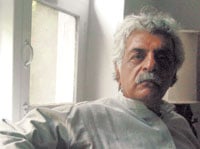 nts.
This is what has been going on in Pakistan for 50 years of our history. Now
the question is: Why can't we break through this. I think the one big chance
Pakistan had of modernising itself and making a new start was at the time of
the break-up of the country. It was a bloody and brutal trauma, especially
for the population of the then East Pakistan.
nts.
This is what has been going on in Pakistan for 50 years of our history. Now
the question is: Why can't we break through this. I think the one big chance
Pakistan had of modernising itself and making a new start was at the time of
the break-up of the country. It was a bloody and brutal trauma, especially
for the population of the then East Pakistan.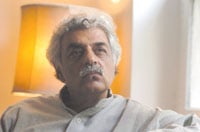 People's Party, later by General Zia's proteges -- the Sharif family -- and
again nothing happened. Their regimes also led to establishment of a new
political elite whose only interest was in making money for themselves and
their cronies and enjoying the power of patronage.
People's Party, later by General Zia's proteges -- the Sharif family -- and
again nothing happened. Their regimes also led to establishment of a new
political elite whose only interest was in making money for themselves and
their cronies and enjoying the power of patronage.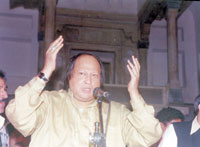 Faisalabad. This city had become famous for the barsi of his father Fateh Ali
Khan which was held regularly every year by his son, Nusrat Fateh Ali Khan.
Faisalabad. This city had become famous for the barsi of his father Fateh Ali
Khan which was held regularly every year by his son, Nusrat Fateh Ali Khan.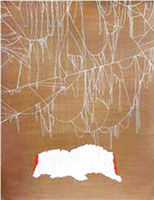 Not infrequently thus one comes across canvases filled with images of a
creature that becomes a sign or mark of identity for the artist.
Not infrequently thus one comes across canvases filled with images of a
creature that becomes a sign or mark of identity for the artist.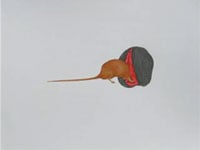 not composed with its double, then the rat is surrounded with another shape
-- a large chilli like vegetable or another fluffy object with a red slit. In
more than one works, the rat or mouse is about to move inside this form that
can not be deciphered; it suggests a female organ. The colour, texture and
the sensation of softness of this form make it an inviting and mysterious
object/entity.
not composed with its double, then the rat is surrounded with another shape
-- a large chilli like vegetable or another fluffy object with a red slit. In
more than one works, the rat or mouse is about to move inside this form that
can not be deciphered; it suggests a female organ. The colour, texture and
the sensation of softness of this form make it an inviting and mysterious
object/entity.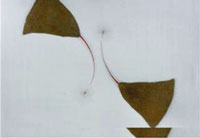 Zeeshan. Here it emerges as a sexual symbol, probably representing the male
presence -- especially in the way it interacts with the shape that is
ambiguous yet evokes a certain body part. Even before the Indian exhibition,
Zeeshan was using the imagery of gun as a prominent motif in his miniatures.
Often that gun was painted next to a banana, or it became a composite of gun
and banana.
Zeeshan. Here it emerges as a sexual symbol, probably representing the male
presence -- especially in the way it interacts with the shape that is
ambiguous yet evokes a certain body part. Even before the Indian exhibition,
Zeeshan was using the imagery of gun as a prominent motif in his miniatures.
Often that gun was painted next to a banana, or it became a composite of gun
and banana.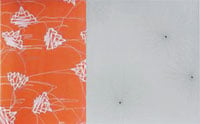 other forms too, for instance in the lines or slits with red openings and red
mass. Both the gaps and circular shapes in red are surrounded with minute
lines -- actually wavy hair. Such hair reappear on the skin of rat too, thus
connecting different visuals.
other forms too, for instance in the lines or slits with red openings and red
mass. Both the gaps and circular shapes in red are surrounded with minute
lines -- actually wavy hair. Such hair reappear on the skin of rat too, thus
connecting different visuals. of lines serves as a structure for the anatomy of a rat, which is facing its
other half -- made of bones, flesh, skin and hairs. The use of lines -- for
whatever purposes -- affirms the skill and command of Muhammad Zeeshan in his
medium and technique: A fact that is further enhanced by the sensitive
rendering of rat.
of lines serves as a structure for the anatomy of a rat, which is facing its
other half -- made of bones, flesh, skin and hairs. The use of lines -- for
whatever purposes -- affirms the skill and command of Muhammad Zeeshan in his
medium and technique: A fact that is further enhanced by the sensitive
rendering of rat.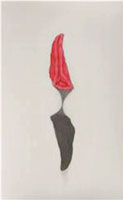 t,
and are using a different image or theme. Although there are varying degrees
of skill and sensibility in the contemporary practitioners of miniature, one
can detect the emergence of sexuality as a favourite subject in the work of
several artists.
t,
and are using a different image or theme. Although there are varying degrees
of skill and sensibility in the contemporary practitioners of miniature, one
can detect the emergence of sexuality as a favourite subject in the work of
several artists. about a decade ago, for street children.
